

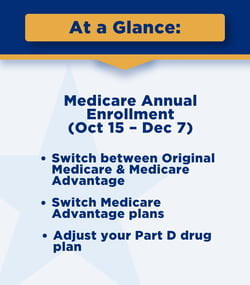
 Between patient schedules, practice management, and retirement planning, finding time to make a decision regarding Medicare is a challenge for any physician. However, with Medicare’s Annual Enrollment Period (AEP) running from October 15 to December 7, taking a few minutes to review your options can prevent costly coverage mistakes.
To help clear up common misconceptions and answer the top questions practicing and retiring physicians ask during this window, here is how TMA Insurance Trust advisors guide physicians through their key Medicare options before the December 7 deadline.
Q: What actually happens between October 15 and December 7?
Advisor: First, it helps to keep in mind that Annual Enrollment is strictly a review-and-change window for existing choices; it’s not the only timing rule you need to track. Decisions tied to turning 65, retiring, keeping group coverage, or buying Medigap follow their own distinct timelines.
But during this specific October 15 to December 7 window, you can:
- Switch between Original Medicare and Medicare Advantage.
- Change from one Medicare Advantage plan to another.
- Enroll in, change, or drop a Part D prescription drug plan.
Q: If I’m happy with my current plan, why review it every year?
Advisor: Because Medicare is definitely not a “set-it-and-forget-it” arrangement. Insurance plans change every year, and so do health needs. A drug plan that worked well this year might alter its pricing, copays, or covered medication list for next year.
Taking 15 minutes to review your plan before December 7 ensures you aren't surprised by higher out-of-pocket costs come January 1. Once the deadline passes, you are generally locked into that plan for the year.

Q: What if I’m 65 or older and still practicing with group coverage?
Advisor: Work status and practice size matter here. This is where we see some of the most expensive misunderstandings happen.
We generally advise that almost everyone enroll in Medicare Part A when they first become eligible at age 65, as long as they qualify for premium-free Part A. However, whether you should enroll in Medicare Part B while still working depends directly on the size of your employer or practice group:
- For practices with 20+ employees: Group coverage stays primary. You can generally enroll in Part A and delay Part B without penalty until you retire.
- For practices with fewer than 20 employees: Medicare becomes primary at 65. Staying solely on a small practice plan without enrolling in Part B can lead to denied claims, severe coverage gaps, and long-term late-enrollment penalties.
We do have one crucial tax warning we always share with physicians: If you enroll in Part A, IRS rules mandate that you must immediately stop making deposits to your Health Savings Account (HSA).
Q: How should I evaluate Part D (Prescription) coverage?
Advisor: Check that your specific medications will still be covered affordably next year.
If you choose to stay on a group plan instead of taking Part D, make sure your practice plan provides "creditable" drug coverage (meaning it pays at least as much as standard Medicare). Going without creditable coverage for more than 63 days can result in a permanent late-enrollment penalty added to your future premiums.
Q: How does a Medicare Supplement (Medigap) plan differ from Part D, and how do its timing rules work?
Advisor: While Part D primarily covers prescription drugs, a Medicare Supplement (Medigap) plan works alongside Original Medicare (Parts A & B) to help pay for out-of-pocket costs that Medicare doesn't cover, like deductibles, copayments, and coinsurance.
Unlike Part D or Medicare Advantage, Medigap plans do not have an annual review window during AEP. Instead, your main opportunity is a one-time, 6-month Medigap Open Enrollment Period that triggers automatically when you enroll in Medicare Part B. This applies when you turn 65 or if you become eligible earlier due to a disability.
During this 6-month window, you have a guaranteed right to buy any Medigap policy sold in your state, regardless of your health history. Once that 6-month window closes:
- You lose your guaranteed issue rights.
- Insurers can require full medical underwriting.
- You may face significantly higher premiums, exclusions for pre-existing conditions, or outright denial of coverage based on your health history.
Help Protect Your Financial Wellbeing
Whether you are a practice owner, employed physician, or locum tenens, healthcare coverage mistakes in your 60s and beyond can cause unnecessary financial loss. TMA Insurance Trust helps Texas physicians evaluate their options and choose the right coverage at the right time so you can avoid these mistakes.
Have more questions about your coverage? Schedule a personalized Medicare review with an experienced advisor by calling 800-880-8181, Monday through Friday, 8:00 AM to 5:00 PM CST.

*Note: The Q&A format above represents a simulated conversation created for educational purposes to illustrate typical questions Texas physicians ask TMA Insurance Trust advisors during Medicare Open Enrollment.